Why Are Pixel Art Beads So Popular Worldwide?
Why Are Pixel Art Beads So Popular Worldwide?
Pixel Art Beads have become a colorful bridge between digital culture and hands-on making. Small plastic beads sit on a pegboard, forming familiar characters, animals, symbols, and personal designs. Each piece feels simple, yet the process demands patience, visual planning, and steady hands.
Bead artist and author Kristen Rask describes this appeal clearly: “Beading gives people a way to slow down, focus, and make something they can hold.” Her observation helps explain why Pixel Art Beads attract children, hobbyists, collectors, and experienced crafters across different countries. The materials are affordable, portable, and easy to understand. A beginner can complete a tiny heart in minutes. A skilled maker may spend hours building a detailed landscape.
The hobby also connects with gaming, animation, social media, and nostalgic design. A finished creation can become wall art, a keychain, a gift, or a conversation starter. Bright colors make progress visible. Mistakes remain visible too. That can be frustrating, but it also makes improvement tangible.
Popularity does not mean perfection.
Some designs look uneven. Some colors may not match the original image. Those small flaws often make handmade work feel more personal. Yet the trend deserves thoughtful attention. Plastic use, safe heating practices, and responsible disposal matter. The global appeal of Pixel Art Beads rests not only on their appearance, but also on accessibility, creativity, and the quiet satisfaction of making something pixel by pixel.
What Pixel Art Beads Are and How They Work
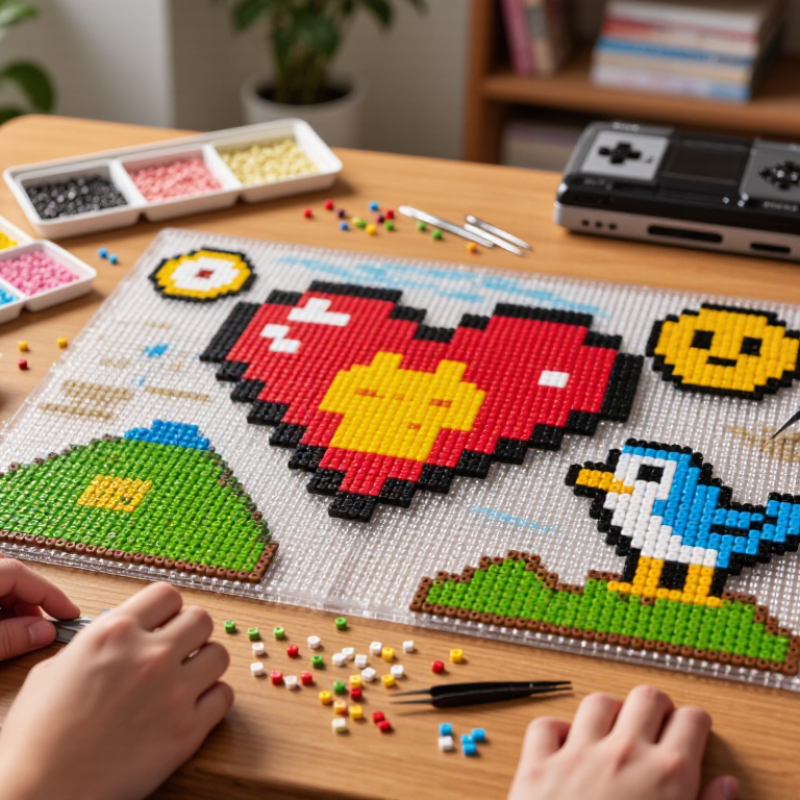
Pixel art beads are small, heat-fusible plastic beads arranged on a pegboard. Each bead acts like one digital pixel. Together, they form animals, game icons, letters, or geometric patterns. The process is hands-on but surprisingly precise. A misplaced bead can change an entire expression.
Creators usually follow a grid pattern, place beads with tweezers, and cover them with ironing paper. Gentle heat softens the bead surfaces and bonds nearby pieces. The finished design becomes a lightweight, flexible decoration. Temperature and timing matter. Too little heat leaves weak connections, while too much heat can flatten details. The method is simple, but not foolproof.
Their appeal reflects a wider craft movement. Grand View Research valued the global arts and crafts market at roughly 46 billion US dollars in 2023, showing strong demand for creative leisure activities. A 2024 report from the Association for Creative Industries also identified crafting as a common stress-relief activity among participating consumers. Pixel art beads fit this behavior well because they combine screen-like visuals with physical making. Small projects can be completed in minutes. Larger designs reward patience and planning. They also offer visible feedback: a blank grid slowly becomes a recognizable image. That process feels satisfying, although repeating tiny patterns can become tiring.
| Dimension | Typical Data or Fact | Why It Matters |
|---|---|---|
| What Pixel Art Beads Are | Small plastic fusible beads with a central hole, commonly made from thermoplastic materials such as polyethylene or related plastics. | The beads function as individual pixels. Their regular shape and consistent spacing make it possible to build recognizable images from simple color blocks. |
| How the Beads Work | Beads are placed on a pegboard, covered with ironing paper or a similar protective sheet, and heated until their surfaces partially fuse together. | Heat creates a permanent or semi-permanent structure while the pegboard preserves the intended grid layout during assembly. |
| Common Bead Sizes | Standard formats are often about 5 mm in diameter, while mini formats may be about 2.5–3 mm and large formats may be about 10 mm. Exact measurements vary by product line. | Smaller beads allow finer details and larger designs in the same area. Larger beads are easier to handle and are often suitable for beginners or young children under supervision. |
| Grid Structure | Each bead occupies one position on a square pegboard grid. Designs are usually planned row by row, similar to a bitmap image. | The grid makes complex illustrations easier to design, count, reproduce, enlarge, or convert into digital pixel-art patterns. |
| Color-Based Construction | Images are created by arranging solid-color beads. Common palettes include basic colors, pastels, transparent tones, metallic effects, and glow-in-the-dark varieties. | A limited palette encourages visual simplification while still supporting characters, animals, symbols, landscapes, and decorative patterns. |
| Heating Requirement | The required heat level and heating time depend on bead size, plastic formulation, iron type, and design thickness. Package instructions should always take priority. | Controlled heating is essential: insufficient heat may leave weak connections, while excessive heat can deform holes, flatten details, or damage the design. |
| Typical Production Steps | Choose a pattern, place the beads, check the color layout, apply heat through protective paper, allow the piece to cool, and remove it from the board. | The process is simple, repeatable, and easy to divide into small stages, making it suitable for both individual projects and group activities. |
| Skill Level | Basic projects require counting, color matching, and careful placement. Advanced projects may involve symmetry, shading, perspective, animation frames, or three-dimensional assembly. | The same material supports a wide range of abilities, from beginner crafts to detailed design and engineering challenges. |
| Why They Resemble Digital Pixel Art | The finished image is built from discrete square-grid units rather than continuous brushstrokes or blended shapes. | This physical process connects screen-based pixel art with hands-on making, allowing digital-looking images to be displayed as tangible objects. |
| Common Finished Products | Frequent outcomes include magnets, keychain decorations, ornaments, coasters, wall art, badges, game-inspired figures, and layered sculptures. | The material is flexible enough for both flat artwork and functional or decorative objects, increasing its appeal across different hobbies. |
| Educational Value | Activities can practice counting, pattern recognition, fine-motor coordination, color classification, spatial reasoning, and step-by-step planning. | The craft combines creativity with structured problem-solving, which helps explain its use in homes, classrooms, libraries, and community workshops. |
| Worldwide Appeal | The basic method is largely language-independent and requires only a small set of tools: beads, a pegboard, a heat source, and protective paper. | Simple instructions, low setup requirements, and the ability to recreate familiar symbols or local cultural designs make the activity accessible in many regions. |
| Customization Potential | Creators can change the grid size, palette, outline thickness, level of detail, and final shape without changing the basic construction method. | Customization supports personal expression, fan art, educational diagrams, seasonal decorations, and original visual storytelling. |
| Durability and Handling | A properly fused piece is lightweight and reasonably durable for decorative use, but thin sections and small protrusions can remain vulnerable to bending or impact. | Designers often strengthen large pieces with thicker shapes, connected sections, or additional structural layers. |
| Safety Considerations | Loose beads can be a choking hazard, and the heating step involves hot equipment and melted plastic. Adult supervision is recommended for children, especially during ironing. | Safe storage, careful heat handling, ventilation, and age-appropriate use are important parts of the crafting process. |
| Environmental Considerations | Most fusible craft beads are plastic and are not designed to biodegrade. Unused beads should be stored for reuse, and disposal should follow local plastic-waste guidance. | Planning patterns carefully and reusing leftover colors can reduce waste while extending the life of the materials. |
This website uses cookies to ensure you get the best experience possible. Learn more.