What Are Trampoline Manufacturers and How Do You Choose One?
Choosing the right Trampoline Manufacturers affects safety, durability, compliance, and long-term operating costs. A trampoline is not merely a steel frame with stretched fabric. It combines welded joints, springs or elastic bands, UV-resistant materials, padding, enclosure systems, and tested load limits. Each detail matters when children land unevenly or several users jump together.
Industry data gives this decision greater weight. The U.S. Consumer Product Safety Commission reported approximately 100,000 trampoline-related emergency department-treated injuries annually during the 2000–2009 period. That figure is older, but it remains a serious safety reference. ASTM International standards, including ASTM F381 and ASTM F2225, address trampoline performance and safety requirements. Buyers should also review relevant ISO testing practices, local product rules, and independent laboratory certificates. Certificates alone are not enough.
Look closely.
Reliable Trampoline Manufacturers should provide traceable material specifications, factory inspection records, test reports, and clear installation instructions. Ask where the steel is sourced, how welds are inspected, and whether replacement mats remain available after several seasons. A strong manufacturer can explain spring fatigue, foam density, frame corrosion protection, and maximum user weight without vague promises. Site audits and sample testing add practical confidence. However, no supplier is perfect. I might overvalue polished documentation while missing inconsistent production batches. Therefore, compare factory evidence with customer feedback, warranty claims, and physical samples. The best choice balances engineering discipline, transparent communication, verified safety data, and realistic after-sales support.
What Is a Trampoline Manufacturer?
A trampoline manufacturer is the company that designs, sources, assembles, and tests trampolines. It is more than a seller with a website. A responsible manufacturer controls the frame, springs, jumping mat, enclosure net, packaging, and quality records. It should explain material grades, load limits, testing methods, and replacement-part support. ASTM F381 provides safety specifications for consumer trampolines, while ASTM F2225 covers trampoline enclosure performance. These standards do not automatically prove perfect quality. They show what should be checked.
Safety evidence deserves attention. A Pediatrics study using U.S. CPSC NEISS data estimated about 98,000 trampoline-related injuries in 2009. That figure is old, but it remains useful for risk planning. The CPSC also advises checking padding, frame condition, and enclosure integrity before use. In factory visits, I would look for consistent welds, covered springs, clear inspection labels, and drop tests. Photos can mislead. A polished product may still have weak stitching or incomplete documentation.
Tips: Ask for current test reports, not marketing claims. Confirm whether an independent laboratory issued them. Check whether the stated weight limit includes one jumper or several. Request spare-part availability and a written warranty. Be cautious when specifications change between the website and the manual. I have seen small details cause expensive problems. A manufacturer that answers technical questions clearly is usually easier to evaluate, although no supplier is flawless.
What Products and Services Do Trampoline Manufacturers Provide?
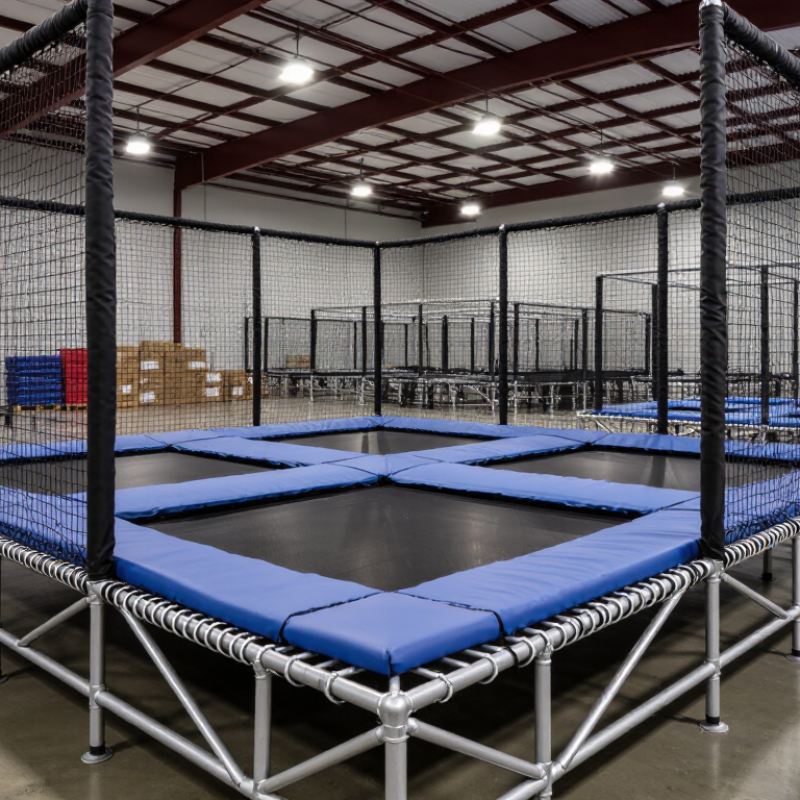
Trampoline manufacturers do more than produce jumping equipment. They develop frames, springs, safety nets, pads, ladders, and anchor systems. Residential models may use compact round frames for gardens, while commercial units often require larger structures and stronger padding. Some manufacturers also create indoor trampoline parks, fitness trampolines, and customized recreational layouts.
Material selection matters. Galvanized steel can resist moisture, while UV-resistant fabric helps protect outdoor jumping mats. Reliable manufacturers provide assembly instructions, load guidance, replacement parts, and maintenance schedules. Many also offer installation services, site measurements, safety inspections, and staff training for commercial facilities. These services can reduce mistakes during setup. Small mistakes matter.
A professional manufacturer should explain testing procedures, warranty limits, material specifications, and expected service life. Ask whether the company checks frame welds, spring tension, net attachment points, and protective padding. Clear documentation is a useful sign of dependable practice. However, no manufacturer makes every design decision perfectly. A softer mat may improve comfort but change bounce performance. A thicker pad may increase protection but add weight and replacement costs. I would compare several technical proposals, inspect sample components, and request references from similar users. Photos alone are not enough. Real support begins after delivery.
How Are Trampolines Designed, Tested, and Produced?
A reliable trampoline begins with a measurable design brief, not a colorful catalog image. Engineers define frame loads, spring tension, mat stretch, enclosure height, and expected weather exposure. They then model stress around welded joints and connection points. ASTM F381 sets safety requirements for trampoline components, assembly, and use. ASTM F2225 addresses manufactured safety-net enclosures. These standards give manufacturers a technical baseline, but compliance alone does not prove excellent workmanship.
Testing should continue after the first successful prototype. A serious factory checks frame deflection, spring fatigue, mat tearing, stitching strength, padding impact, and net attachment. Samples may face repeated jumps, uneven loading, ultraviolet exposure, and temperature changes. The U.S. Consumer Product Safety Commission has reported roughly 100,000 trampoline-related emergency-department injuries annually during earlier surveillance periods. That figure makes quality control more than a marketing detail. It also suggests a difficult question: are laboratory tests severe enough to represent years of family use?
Production quality depends on traceable materials and consistent assembly. Inspectors should verify tube thickness, weld penetration, foam density, spring dimensions, and sewing patterns. Random sampling helps, though it can miss a recurring defect. Better manufacturers retain batch records, calibrate testing equipment, and investigate failed units instead of quietly adjusting paperwork. When choosing one, request test reports, standard references, warranty terms, replacement-part availability, and clear installation instructions. Ask who performed the testing. A polished certificate can still hide weak evidence.
Common Residential Trampoline Sizes and Key Manufacturing Considerations
Residential round trampolines are commonly sold in nominal diameters of 8, 10, 12, 14, and 16 feet. During design and production, manufacturers match the frame, springs, jumping mat, enclosure, and padding to the selected diameter. Quality programs typically include dimensional inspection, material checks, assembly verification, load testing, repeated-use or fatigue testing, and outdoor weather-resistance evaluation. Buyers should also review applicable safety standards, test documentation, warranty terms, replacement-part availability, and the manufacturer’s quality-control process.
What Standards Should a Reliable Manufacturer Meet?
A reliable trampoline manufacturer should meet clear safety standards, not merely offer attractive catalog photos. Look for testing against relevant requirements, such as ASTM specifications or EN 71-14 for domestic trampolines. The exact standard depends on the product’s market and intended use. Ask for current test reports that match the precise model, frame size, mat, springs, and enclosure. Paperwork is not proof. Details matter.
Material control is equally important. The manufacturer should identify steel grades, coating methods, mat fabric, spring strength, and UV resistance. A dependable factory checks welds, frame alignment, stitching, padding thickness, and enclosure connections during production. Quality records should include batch numbers and inspection results. This makes defects easier to trace. It also shows whether quality control is routine or performed only before shipment.
A factory audit can reveal more than a sales presentation. Walk through the production line and inspect storage conditions. Damp cartons, mixed components, or unmarked materials deserve questions. Reliable manufacturers should explain their sampling process and corrective actions when a test fails. They should also provide clear assembly instructions, warning labels, spare-part support, and responsive communication. I would not choose a supplier based on certification alone. Some certificates may be outdated, incomplete, or unrelated to the final product. A small sample test is wise, although it cannot replace independent laboratory evaluation. No factory is flawless. The important point is whether it notices weaknesses and fixes them consistently.
How Do You Choose the Right Trampoline Manufacturer?
Choosing the right trampoline manufacturer requires more than comparing prices. According to Grand View Research, the global trampoline market was valued at about USD 2.9 billion in 2023. That growth attracts capable factories, but also inconsistent quality. Ask for current test reports, production photographs, and batch-level inspection records. The documents should identify material grades, test methods, and laboratory dates. Vague certificates are warning signs.
Safety evidence matters most.
A reliable manufacturer should demonstrate compliance with relevant standards, such as ASTM F381 for trampoline equipment. Request records for frame strength, spring fatigue, enclosure-mesh performance, and UV exposure. The U.S. Consumer Product Safety Commission reported 103,512 trampoline-related injuries treated in emergency departments during 2021. This figure makes quality control more than a marketing issue. Inspect the welds closely. They should look even, without sharp edges or visible gaps. Ask whether the factory tests several units from every production batch, not just one sample.
Do not ignore after-sales support. Confirm spare-part availability for pads, springs, nets, and poles. Clarify warranty limits, replacement procedures, and response times in writing. A factory audit can reveal crowded storage, weak packaging, or rushed final inspections. I would not trust a polished catalog alone. No manufacturer looks perfect on paper. The better choice is the one that admits limitations, shares measurable evidence, and improves its process when defects appear.